

The Largest Alligator Ever Caught in Louisiana Was Never Actually Verified
LAFAYETTE, La. (KPEL News) — Louisiana has more alligators than any other state in the country, and it is not even close. The Louisiana Department of Wildlife and Fisheries puts the wild population at more than 3 million, with another million on farms. That is roughly three times Florida’s gator population.
Numbers like that mean Louisiana has always produced some absolute giants. But the biggest one of all time? That story starts more than 130 years ago on a cold January night in the marshes south of Avery Island.

The 19-Foot Legend: Edward McIlhenny and the Marsh Island Giant
On January 2, 1890, a 17-year-old named Edward “Ned” Avery McIlhenny set out from Avery Island with two companions to hunt geese. They sailed south through the bayous into Vermilion Bay and got becalmed near the mouth of a shallow, silted-in bayou close to Marsh Island.
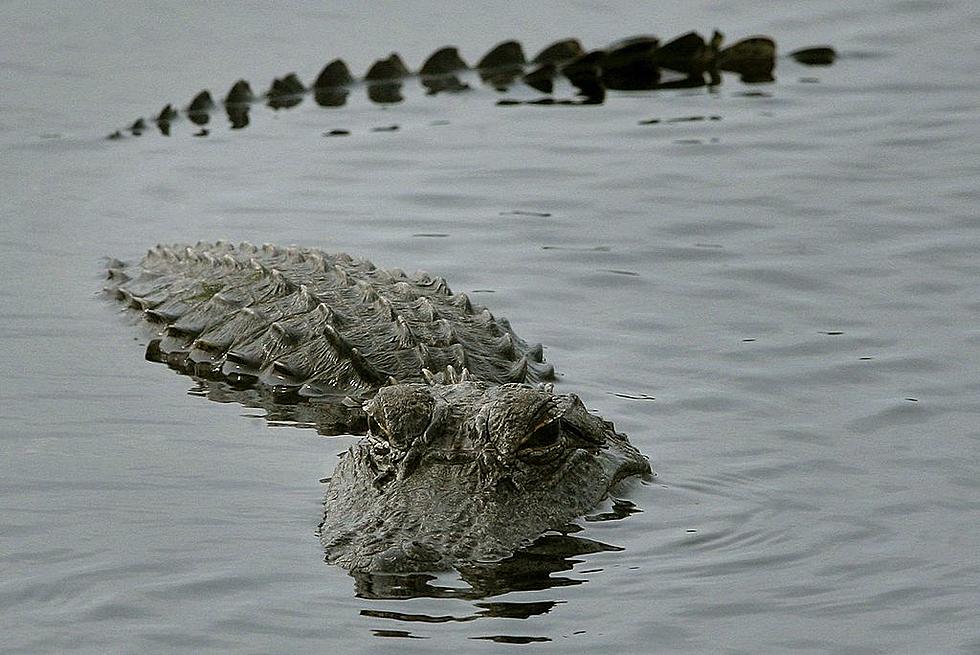
Walking the bank with his shotgun at dusk, McIlhenny shot two mallards and waded into the marsh to retrieve them. He spotted what he thought was a partially submerged log. It was not a log. It was an enormous alligator, sluggish and dying from exposure to the cold air. McIlhenny shot it in the head, according to a detailed account published in Country Roads Magazine.
The next morning, McIlhenny and his two companions returned with rope and tried to drag the carcass out of the marsh. The gator was too large and the bog too soft. They could not budge it. So McIlhenny measured the animal in sections using the barrel of his shotgun, which he knew to be 30 inches long, and declared the total length: 19 feet, 2 inches. No photograph. No skull preserved. No second measurement. Just a teenager with a shotgun barrel.
McIlhenny eventually took over his family’s business, the McIlhenny Company, which produces Tabasco sauce on Avery Island about 25 miles south of Lafayette. He became a noted naturalist and conservationist, helped establish the Rockefeller Wildlife Refuge, wrote The Alligator’s Life History in 1935, and founded the Bird City wildfowl refuge that helped save the snowy egret from extinction. He was also, by his own company’s admission, a gifted storyteller.
The McIlhenny Company historian put it plainly: Ned was “well-known on the island for his gift for spinning yarns.” He also once claimed to have introduced nutria to Louisiana. His own company has publicly debunked that one.
Why Scientists Question the Record
The 19-foot-2-inch measurement has been listed by the Louisiana Alligator Advisory Council and referenced by LDWF as the state’s record. But scientists have questioned it for years, and the reasons are not hard to understand.
McIlhenny took the measurement with a shotgun barrel in boggy, uneven terrain, in conditions that would make precise measurement difficult even with professional equipment. He did not write the account until his 1935 book, 45 years after the incident. Nobody preserved any part of the specimen for independent verification.
Researchers in Florida developed mathematical models to estimate total alligator length based on skull measurements. When they applied those models to old skulls from alleged record-holders, the predicted lengths fell well short of the declared measurements. One supposed record specimen came out closer to 14 feet 10 inches, not the much longer length originally claimed.
LDWF does not officially certify alligator records the way it does for some game species. The agency tracks harvest data, including lengths, but there is no formal verification system equivalent to a state fishing record.
Nobody is saying the Marsh Island gator was small. It was clearly a massive animal. But whether it was truly 19 feet 2 inches is an open question that will never be settled.
The Biggest Verified Catches in Modern Louisiana
While the 1890 legend gets all the attention, Louisiana hunters have landed some enormous alligators in recent years with proper measurements and verified weights to back them up.
13 feet 9 inches, 890 pounds — Sicily Island, 2023. Hunter Soileau and Jered Cizek pulled this animal out of the waters near Sicily Island in September 2023. Soileau, a guide with Full Strap and Stringer Outfitter and Guide Service, said the fight lasted close to two hours. A .22 caliber was not enough to finish it. They switched to a 9mm. Maranda Swain of Arkansas made the kill shot. After four days in a cooler, the gator weighed 890 pounds. Soileau believes it was heavier when first caught and estimated the animal was between 70 and 100 years old. The Louisiana Sportsman covered the catch in detail.
13 feet 5 inches, 900 pounds — “The Monster of the Marsh,” 2013. Mother-daughter duo Liz and Jessica Cavalier caught this one while filming the TV show Swamp People. It remains one of the biggest gators ever taken on the show.
13 feet 4 inches, 760 pounds — West Baton Rouge Parish, 2013. Jim White of Ventress had been watching this gator for five years before he took it on September 14, 2013. White, a 34-year veteran of the Louisiana Department of Transportation and Development, needed a tractor with a front-end loader to get the animal out of the water. The middle of its body measured 68 inches around, and the two jaw-meat pieces alone weighed 22 pounds when processed. “I definitely had gator fever,” White told the Louisiana Sportsman. He was not weighed until two days later, and people told him the animal may have been 20 pounds heavier fresh.
11 feet 8 inches, estimated 800 pounds — Lake St. John, 2022. Two hunters pulled this gator from Lake St. John in Concordia Parish during the 2022 season. Nathan Gauthier posted a Facebook Live video of the harvest and said the hunters fought the animal for two hours to get it into their boat.
How Louisiana’s Alligator Population Exploded
Louisiana produces gators this big because of a conservation program that took decades to build. In the early 1960s, the wild alligator population had crashed to fewer than 100,000 after generations of unregulated hunting. The state shut the season down entirely from 1962 to 1972 to let populations stabilize.
During that closed period, researchers at the Rockefeller Wildlife Refuge in Cameron Parish ran intensive studies on alligator nesting, habitat needs, and population dynamics. Scientists like Ted Joanen, Larry McNease, Ruth Elsey, and Mark Staton built the guidelines that became the backbone of the modern management program.
The core idea was straightforward: saving the alligator meant saving the wetlands. More than 80 percent of Louisiana’s coastal wetland habitat is privately owned, so LDWF created a controlled harvest program that gave landowners direct economic incentive to maintain and protect their marshes. The alligator became a cash crop, and the habitat it depended on gained protectors.
Since the program launched in 1972, more than 1.1 million wild alligators have been harvested, more than 11 million eggs have been collected, and roughly 7.3 million farm-raised alligators have been sold. The wild population went from fewer than 100,000 to more than 3 million.
Alligator farming is now a major Louisiana industry. In 2024, Louisiana farmers harvested 300,935 farm-raised alligators worth an estimated $72 million. Wild hunters took 32,335 alligators in the 2024 season, the highest harvest total since 2016. Nearly 2,900 licensed alligator hunters participate each year.
The 2025 Season Is Getting Longer
The population rebound worked so well that the Louisiana Wildlife and Fisheries Commission extended the 2025 hunting season. The new dates run from the last Wednesday in August through December 31 in the East Zone and from the first Wednesday in September through December 31 in the West Zone. That is a big jump from the previous 60-day window.
State lawmakers pushed hard for the change. “We’re being overrun by alligators,” one legislator said during a 2023 hearing. Another said she has spotted gators larger than her kayak while paddling.
LDWF fields between 3,000 and 4,000 nuisance alligator complaints every year, according to LDWF biologist Jeb Linscombe. Hunters harvest or relocate between 1,500 and 2,000 of those animals annually.
Where the Big Ones Still Live
Louisiana has roughly 4.5 million acres of alligator habitat, according to LDWF. Coastal marshes make up more than 3 million of those acres, followed by cypress-tupelo swamps at about 750,600 acres, the Atchafalaya Basin at 207,000 acres, and lakes at 32,105 acres. Alligators live in all of it.
A few spots stand out for producing the biggest animals.
The Atchafalaya Basin. The largest river swamp in the United States spans nearly a million acres of deep water, abundant prey, and quiet bayous perfect for nesting. If a gator wants to grow old and fat, this is the place to do it. Multiple tour operators run guided trips through the basin.
Rockefeller Wildlife Refuge, Cameron Parish. This 76,000-acre coastal refuge has the highest alligator nesting densities of any place in the United States. Much of what we know about alligator management came from research conducted here. LDWF does not allow kayaking or canoeing on the refuge because of the density of large alligators.
Lake Martin, St. Martin Parish. Located just seven miles from Lafayette near Breaux Bridge, Lake Martin sits within the 9,500-acre Cypress Island Preserve. Gators are regularly visible from Rookery Road, the gravel route that circles the lake. The shallow, relatively clear water makes them easier to spot than in deeper swamps.
Caddo Lake, Caddo Parish. This 26,810-acre lake straddles the Louisiana-Texas border and produces some of the biggest individual alligators in the state. A 13-foot-2-inch, 900-pound gator was taken from the area in 2016.
Marsh Island Wildlife Refuge and the Toledo Bend/Sabine River system have turned out historically large catches as well.
What to Do If You Encounter an Alligator
LDWF keeps its safety advice simple. Alligators naturally fear humans and usually retreat quickly. If you see one within a few yards, back away slowly. If it hisses, you are too close. Never feed alligators, and keep pets on a leash near any body of water.
Alligators less than four feet long are not typically a threat. Gators over four feet that are approaching people, pets, or livestock should be reported to LDWF at (337) 373-0032 or (225) 765-2811. After hours and weekends, call (800) 765-2811.
Since the 1970s, there have been fewer than 25 alligator attacks on humans in Louisiana. Fatal attacks are extraordinarily rare.
Louisiana's Top Outdoor Adventures
Gallery Credit: Joe Cunningham
